
English Electric (GAF) Canberra Mk.20: Australia’s Jet-Powered Bomber
The arrival of the Canberra Mk.20 marked a decisive shift in Australian military aviation. Built locally and flown on active operations overseas, it represents both technological progress and the people who operated it during a period of global change.
As the nation’s first jet-powered bomber, the English Electric Canberra moved the Royal Australian Air Force beyond the limits of piston-engine aircraft and into an era defined by speed, altitude and reach. This was not an incremental improvement, but rather a fundamental change in how air power was conceived and delivered.
A New Era of Flight — The Birth of the Canberra
Before the English Electric Canberra bomber entered service, bomber operations were still shaped by Second World War thinking. Aircraft relied on piston engines, defensive gun positions and formations to survive — with performance limited by speed, altitude and endurance. Even highly capable aircraft like the Mosquito operated within the constraints of propeller-driven flight and emerging air defence systems.
That changed when the Canberra English Electric first flew in 1949. Designed from the outset as a jet bomber, it demonstrated that speed and altitude could replace armour and armament as the primary means of protection. Jet propulsion allowed it to cruise higher and faster than many fighters of its day, reshaping expectations around survivability, reach and mission flexibility at the dawn of the Cold War.
Australia recognised this shift early. To strengthen national defence and support local industry, the Government Aircraft Factory built the GAF Mk20 Canberra under licence. Australia later operated the English Electric Canberra TT18 in the target-towing role and also built them locally.
Service with the RAAF — Australia’s Canberra Mk.20 Legacy
The Canberra Mk 20 bomber undertook extended operational service beyond home bases. In Malaya, the aircraft supported regional security efforts during a period of instability, while its deployment to Vietnam with No. 2 Squadron marked the RAAF’s entry into sustained jet bomber operations in a complex combat environment. Across both theatres, the Canberra proved dependable and adaptable — valued for its ability to deliver consistent results under demanding conditions rather than dramatic display.
At home, the RAAF Mk20 Canberra formed a central part of Australia’s jet strike capability. Operating from bases such as RAAF Amberley, it provided a permanent and credible bomber force, while facilities like RAAF Woomera supported testing, training and evaluation. Together, these bases underpinned the aircraft’s effectiveness and helped integrate jet bombers into everyday RAAF service.
Following its frontline bombing role, the English Electric Canberra in Australia transitioned into photo reconnaissance duties to extend its usefulness as operational requirements evolved.
Technical Innovation and Performance
Jet propulsion reshaped bomber design, and the Canberra Mk.20 was engineered to take full advantage of that shift. Its twin Rolls-Royce Avon turbojets delivered high speed and sustained high-altitude performance, while reducing the reliance on defensive armament and changing how survivability was achieved.
Size & Payload Capacity
- Status: On display
- Type: Three-seat bomber and photo reconnaissance aircraft
- English Electric Canberra first flight: 13 May 1949
- Manufacturer: English Electric (UK), Government Aircraft Factory (Australia under licence)
- Powerplant: Two Rolls-Royce Avon R.A.7 Mk.109 turbojets
- English Electric Canberra maximum speed: 933 km/h at 40,000 ft
- Service ceiling: 15,000 m
- Range: Combat radius approx. 1,300 km
- Number of English Electric Canberras built: 1,352 worldwide
Inside the Cockpit — The Canberra Crew Experience
Operating the Canberra Mk.20 required close coordination between its three crew members: pilot, navigator and bomb aimer. Each role was distinct, yet interdependent, with mission success relying on precision rather than automation. The English Electric Canberra cockpit environment reflected the early jet age, functional and purposeful rather than ergonomic by modern standards.
Twin Avon engines produced constant vibration and noise, while high-altitude flight introduced its own physical demands. The English Electric Canberra crew worked within a confined space, guided by instruments that represented the cutting edge of their time but required discipline and training to master.
For visitors today, viewing the preserved cockpit offers insight into the English Electric Canberra interior faced by crews and the professionalism required to operate one of Australia’s first jet bombers safely and effectively.
Cold War Service and Global Impact
The English Electric Canberra entered service at a time when Cold War tensions reshaped air power across Europe, the Middle East and Southeast Asia. Operated by air forces in the United Kingdom, Australia, India and South America, it filled roles ranging from high-altitude bombing to reconnaissance and target towing. Its ability to operate from established bases and austere airfields alike made it a practical asset as defence priorities shifted across regions and decades.
During the Suez Crisis, the English Electric Canberra aircraft was used by the Royal Air Force for long-range bombing and reconnaissance missions flown from bases in Cyprus. Its ability to operate at high altitude with precision over extended distances demonstrated how jet bombers could support coalition operations without relying on heavy fighter escort. These missions reinforced Canberra’s value as a strategic tool in early Cold War operations, where reach and reliability mattered as much as speed.
See the Canberra Mk.20 Up Close at the Aviation Heritage Museum
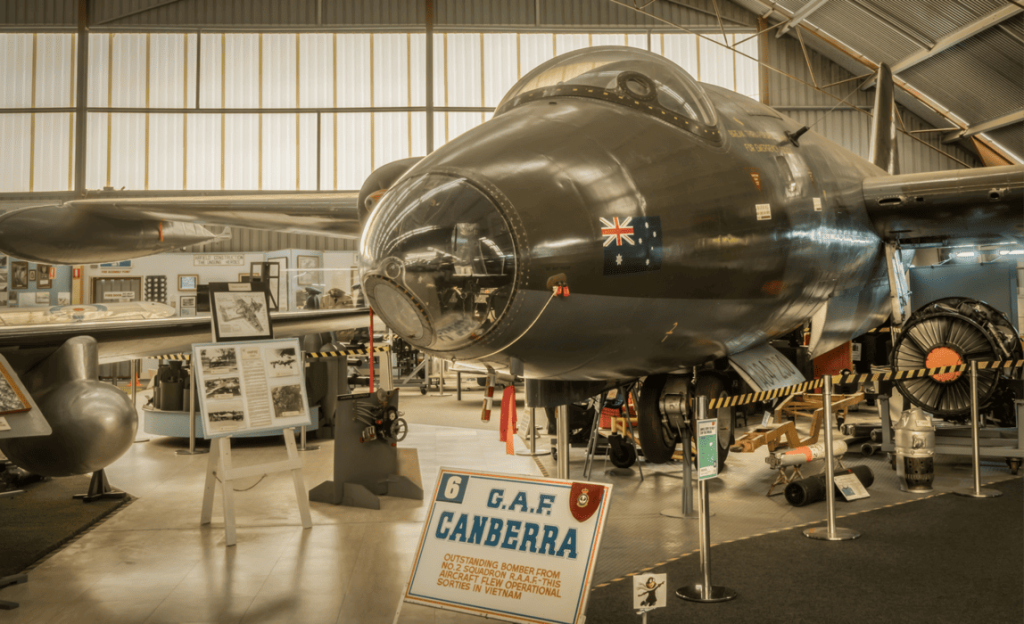
The Canberra Mk.20 on display at the Aviation Heritage Museum carries RAAF serial A84-230 and reflects a full operational life rather than a static prototype. Built at Fishermen’s Bend in 1955, it entered RAAF service in 1957 and later served overseas before returning to Australia.
Its preserved condition highlights the aircraft’s size, clean lines and jet-age design philosophy. Displayed alongside other significant aircraft such as the Spitfire, Lancaster and Tornado GR4, the Canberra provides a clear visual link between wartime aviation and Cold War air power.
Plan Your Visit
The Canberra Mk.20 is on display at the Aviation Heritage Museum in Bull Creek, Western Australia, just south of Perth. The Museum is open daily from 10.00 am to 4.00 pm, and it is the ultimate day of fun for aviation enthusiasts of all ages!
Frequently Asked Questions
Is the English Electric Canberra still flying today?
A handful of English Electric Canberras were still flying in the 2000s, but most are now being preserved in museums.
How fast was the Canberra Mk.20?
The English Electric Canberra’s maximum speed is 933 kilometres per hour at high altitude.
How many Canberra bombers were built?
A total of 1,352 Canberra aircraft were built worldwide across the United Kingdom, Australia and the United States
When was the English Electric Canberra’s first flight?
The Canberra first flew on 13 May 1949.
What role did the Canberra Mk.20 play in the RAAF?
The Canberra Mk.20 served as Australia’s primary jet bomber and later as a photo reconnaissance aircraft during the Cold War period.