
Dakota C-47
Have you ever stood beneath the wings of history and felt its presence? At the Aviation Heritage Museum, the C-47 Dakota gives you that rare chance. This iconic aircraft was the backbone of Allied air operations in World War II. It began life as a Douglas DC-3 airliner before being transformed into a rugged military transport built for combat zones and remote airstrips.
The C-47 Skytrain Dakota served in every major theatre of the war, from dropping paratroopers over Normandy on D-Day to flying supplies across the Himalayas during the Hump campaign. Its reliability, range and load capacity made it one of the most important aircraft of the 20th century.
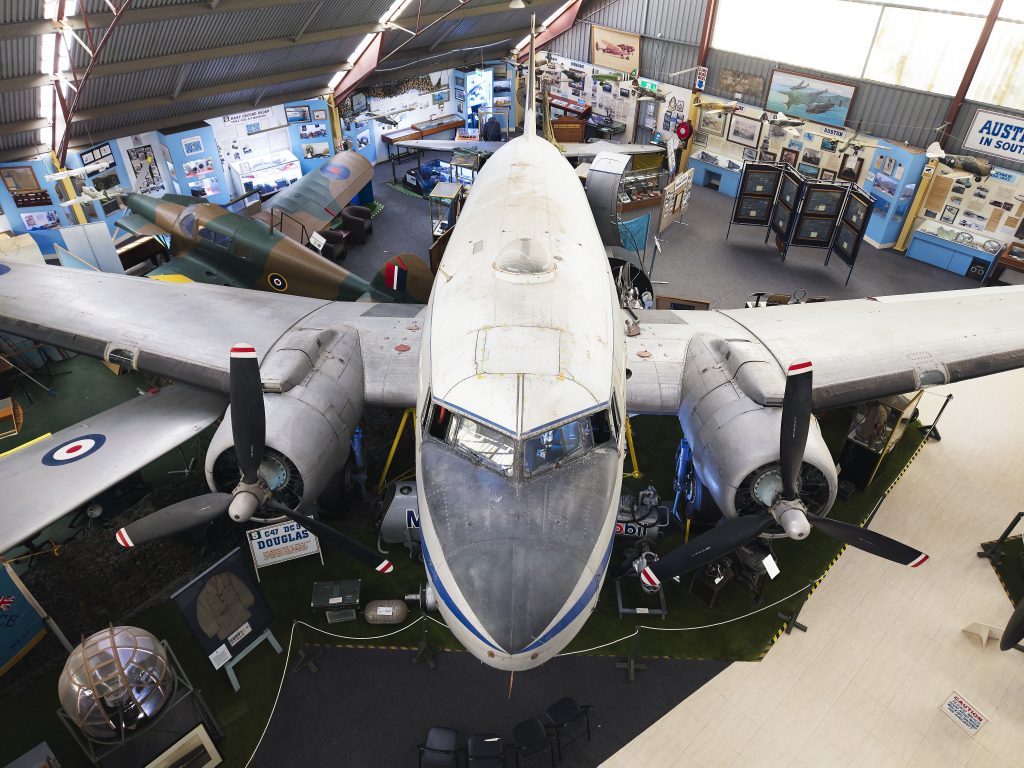
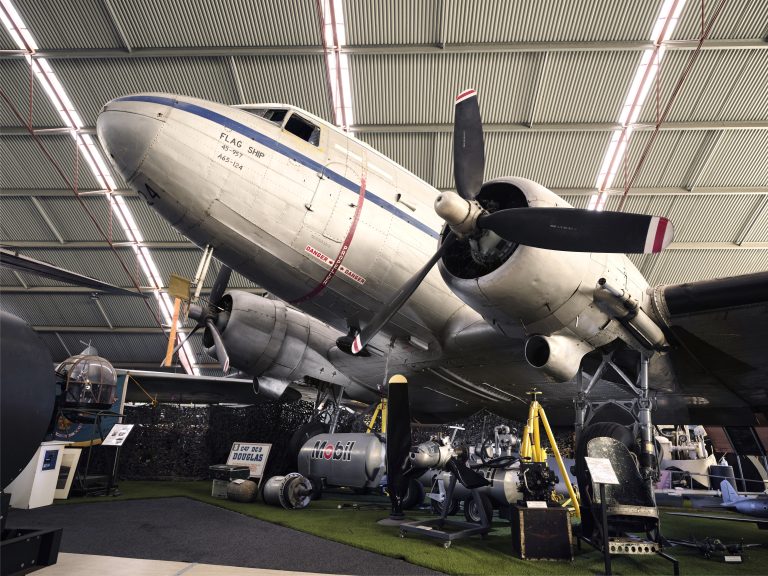
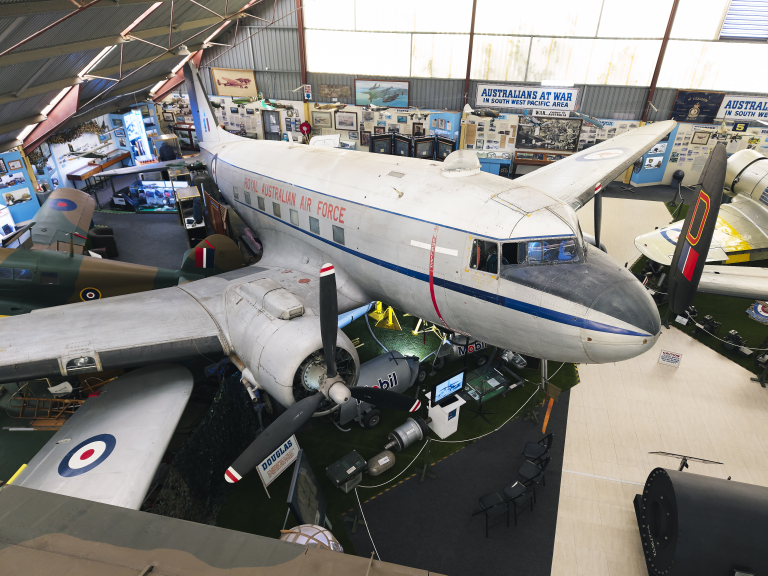
The aircraft on display—serial A65-124—was the last C-47 Dakota plane acquired by the Royal Australian Air Force, and it was delivered in August 1945. Preserved in its original configuration, it offers visitors a rare glimpse into the aircraft’s wartime life and post-war service.
A Legendary Aircraft of the Second World War
The Douglas Dakota C-47 traces its roots to the revolutionary Douglas DC-3, a civilian aircraft that first took to the skies in 1935 and changed commercial aviation forever. Its success quickly caught the attention of the US Army Air Forces, who adapted the design into a rugged military version—the C-47 Skytrain Dakota—built to carry troops, cargo and paratroopers into active war zones.
In Commonwealth service, the aircraft became known simply as the Dakota. Some suggest the name came from the acronym “Douglas Aircraft Company Transport Aircraft” (DACoTA), though its widespread use soon overshadowed any official explanation. Regardless of its name, the Dakota was indispensable. It could take off and land on short, rough airstrips, handle heavy loads and fly long distances with impressive reliability.
Over 10,000 were produced in the United States alone, with thousands more built under licence around the world. More than just a transport, the Douglas C-47 Skytrain Dakota became the logistical backbone of the Allied air campaign—a dependable workhorse that delivered results under pressure.

The Role of the Dakota C-47 in the Allied Forces
The Dakota C-47 was never designed to grab headlines, but it became one of the most critical tools in the Allied arsenal. Its strength wasn’t in firepower but in reliability—delivering troops, medical supplies, equipment and hope across vast, contested territory.
The C-47 Skytrain Dakota was involved in several defining missions of World War II:D-Day (Normandy, 1944): Carried American paratroopers of the 101st and 82nd Airborne Divisions behind enemy lines under cover of darkness. These drops were vital in securing key positions before the main landings.
- The Hump (India–China supply route): Braved violent storms, freezing altitudes and Japanese fighters to fly supplies over the Himalayas—a lifeline for Chinese and Allied forces.
- Operation Market Garden (Netherlands, 1944): Dropped thousands of paratroopers behind German lines in one of the largest airborne assaults of the war.
- Pacific Theatre (RAAF operations): Flew missions across New Guinea and Borneo, later supporting deployments in Korea and Vietnam with troop movements and supply runs.
The C-47 Dakota plane may not have been flashy, but it was essential. It flew the missions others couldn’t—and often wouldn’t. In every campaign it touched, the Dakota enabled the fight.
Key Specifications & Technical Details
Built to be tough, reliable and remarkably versatile, the Douglas Dakota C-47 wasn’t just another military transport. It was a lifeline. Its ability to fly long distances, carry heavy loads and operate from short, makeshift runways made it invaluable across every Allied campaign.
Technical information:
- Status: On display
- Type: Military transport (C-47) / Commercial transport (DC-3)
- Maiden flight: DC 1 (forerunner to development of C-47) 1st July 1933
- Manufacturer: Douglas Aircraft Company
- Primary users: United States Army Air Force, US Air Force, RAF, RAAF and multiple international air forces and airlines
- Number built: 10,048 (US) + 4,937 (Soviet Li-2) + 487 (Japanese L2D) = 16,079 total
Performance specifications:
- Length: 19.43 m (63 ft 9 in)
- Height: 5.18 m (17 ft 0 in)
- Wingspan: 29.11 m (95 ft 6 in)
- Powerplant: 2 × Pratt & Whitney R-1830-90C “Twin Wasp” radial engines, 1,200 hp (895 kW) each
- Empty weight: 8,040 kg (17,720 lb)
- Loaded weight: 12,200 kg (26,900 lb)
- Maximum speed: 360 km/h (224 mph)
- Range: 2,600 km (1,600 mi)
- Service ceiling: 8,050 m (26,400 ft)
Stories from the Crew: First-Hand Accounts
For the men who crewed the C-47 Dakota plane, it was more than metal and rivets; it was their lifeline. Crews flew into combat zones, dropped paratroopers into darkness, and navigated dangerous weather and enemy fire to deliver what mattered most.
During the D-Day invasion, veterans of the 101st and 82nd Airborne recalled the tense silence inside Dakotas as they approached the French coast. With only red cabin lights and the hum of engines, hundreds of young soldiers prepared to jump into occupied territory. Many described it as the longest flight of their lives.
Allied pilots flying “The Hump” between India and China described the route as one of the most perilous of the war. They faced extreme turbulence, oxygen-starved altitudes, and unpredictable weather, but the mission’s importance outweighed the risk. RAAF crews flying Dakotas like A65-124 also operated across New Guinea and Borneo, often landing on rough strips to resupply forward units.
Explore the Aircraft Up Close at Our Museum
The Douglas C-47 Skytrain Dakota on display at the Aviation Heritage Museum isn’t a replica or restoration—it’s the real thing. Serial A65-124, the last C-47 Dakota delivered to the RAAF, has been preserved in original working condition, offering a rare, authentic encounter with military aviation history.
Visitors can examine the aircraft up close, including the cockpit with its final-era RAAF instruments, and the military seating still in place from its service in Vietnam and Butterworth. From the worn fittings to the weathered paintwork, every detail tells a story.

Take the Dakota C-47 Tour
Step inside history with a guided Dakota C-47 tour—one of the Aviation Heritage Museum’s most popular experiences. Over 30 to 45 minutes, expert guides walk you through the aircraft’s cockpit, cargo bay and interior, sharing stories of the crews who once flew it.
You’ll explore original seating layouts, control surfaces and interactive displays that bring its operational history to life. It’s immersive, educational, and unlike any static exhibit you’ve seen.
Visiting Information & Exhibit Highlights
We are open daily from 10 am to 4 pm in Bull Creek, Perth. Admission is $15 for adults, $7.50 for children and $30 for families, with concessions and group bookings available. To plan your visit, view our Visitor Information page.
While the C-47 Dakota is a standout, it’s just one of many historic aircraft on display. Don’t miss the
- Avro Lancaster
- Spitfire
- Consolidated Catalina
- Tiger Moth
Explore our rare WWII collection and experience Australian aviation history like never before.
Frequently Asked Questions
What is the wingspan of the Dakota C-47?
The Douglas Dakota C-47 has a wingspan of 29.11 metres (95 feet 6 inches), designed for stable low-speed flight during supply drops and parachute missions.
How many Dakota C-47s are left?
More than 1,000 C-47 Dakotas survive today, mostly in museums or private collections, though only a small number remain airworthy.
How many Dakota C-47s are still flying?
Around 150 to 200 C-47 Dakotas are still flying worldwide, often used in air shows, historical reenactments and commemorative events.
How many Dakota C-47s were built?
Over 10,000 were built in the US. With Soviet (Li-2) and Japanese (L2D) versions included, total production exceeds 16,000 aircraft.
Can visitors go inside the Dakota C-47 cockpit?
Yes, guided tours include access to the C-47 Dakota cockpit, where you can view its original RAAF controls and sit where pilots once flew.